
Water security for future generations.
Support East Maui Water Authority in acquiring the East Maui Water License.
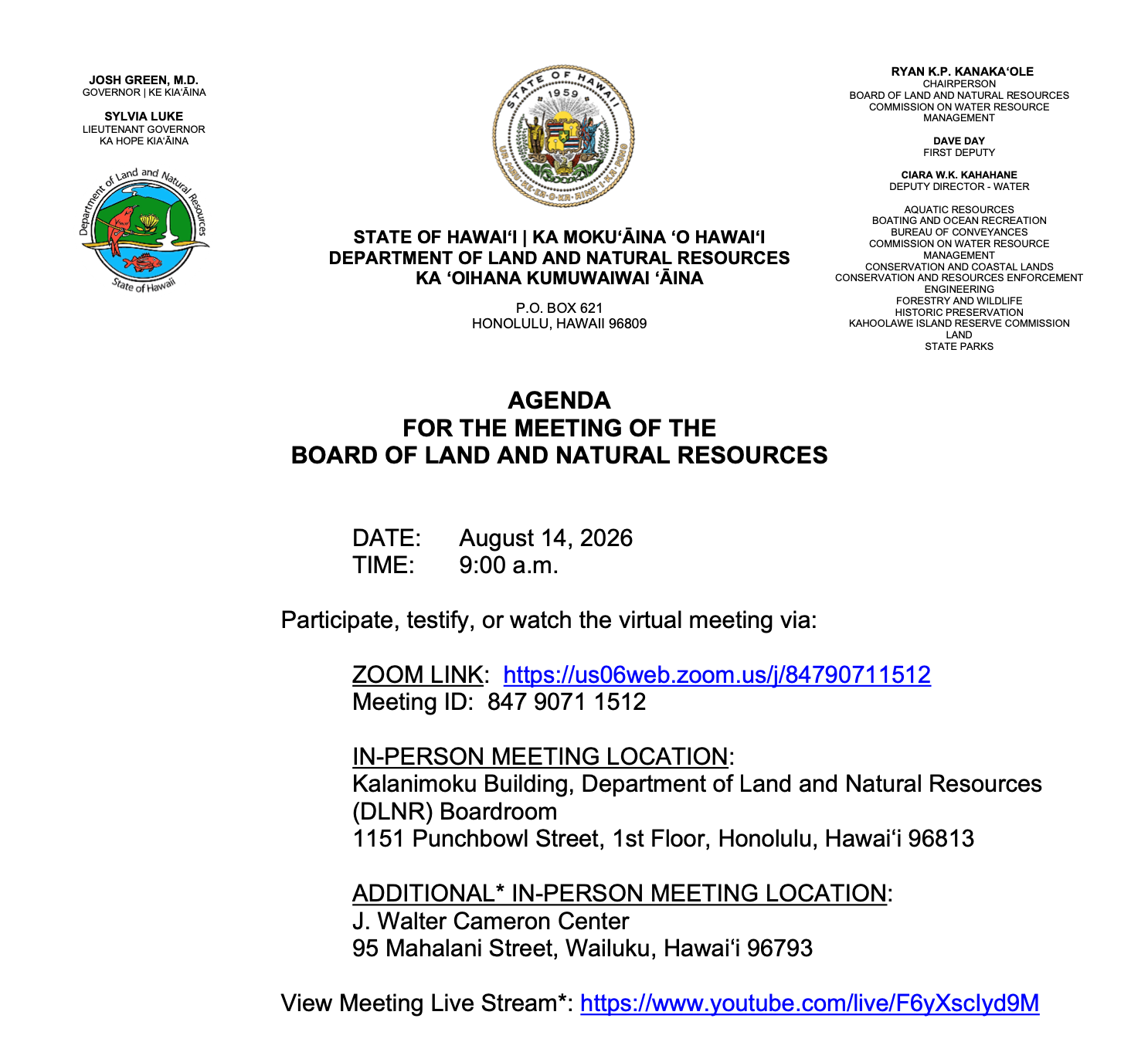
AUG. 14th - STATE OF HAWAII
BLNR MEETING
Please see below to submit testimony by Thursday, August 13 2026 9am.
Your Kōkua Makes a Difference
Your donation supports our ongoing aloha ʻāina efforts, from water advocacy and participation at upcoming water meetings to hands-on ahupuaʻa restoration projects.
At checkout, please select where you would like your kōkua directed: Water Advocacy or Ahupuaʻa Restoration.
Mahalo nui for your continued loyalty, generosity, and commitment to protecting our wai, ʻāina, and aloha ʻāina lāhui for generations to come.
On Friday, August 14, the Board of Land and Natural Resources (BLNR)
will decide on agenda item D-7 – whether to issue a 30-year license
to Mahi Pono for the continued diversion of East Maui waters.
Tell BLNR - E Hoʻi ka Wai! Return East Maui Waters!
The days of plantation-era water control are over. Instead, BLNR should honor Maui County’s request to manage the license area and ditch through the integrated County of Maui’s Department of Water Supply and East Maui Water Authority (EMWA), which includes a regional advisory board created by Maui voters for this exact purpose.
Submit Testimony on Agenda Item D-7 by
Thursday, August 13, at 9:00 a.m.
Testimony received after the deadline will be accepted, but will be considered late. If you wish to testify via videoconference (Zoom),you must email a request to do so in advance.
See further details on how to participate on the BLNR agenda.
Watch the BLNR meeting live on youtube.
REJECT a 30-year water license to Mahi Pono that would perpetuate the continued use of outdated structures known to waste precious wai;
SUPPORT the County of Maui's proposed set aside for County and community-based stewardship of East Maui waters;
UPHOLD constitutional public trust duties to protect Native Hawaiian traditional and customary practices, and other public trust purposes; and
ENSURE that any license allows taking of water only in amounts needed to meet a proven reasonable beneficial end use and that auction prices reflect the full value of state-owned assets utilized by private commercial water diverters.
E Ola I Ka Wai!
Summary of the Fight for East Maui Water:
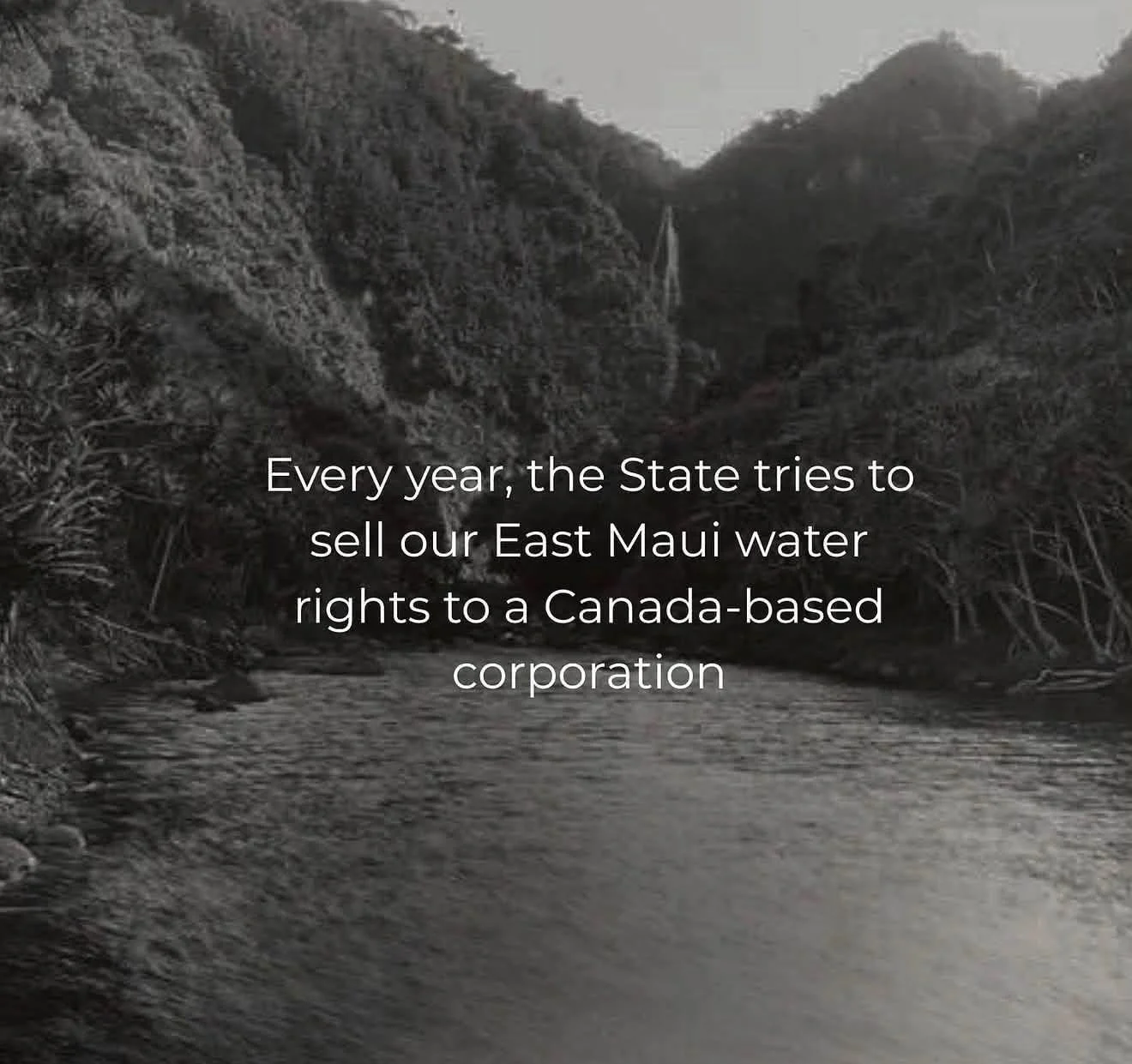
Since 1881, when East Maui petitioners urged the Crown Lands Commission to deny “millionaire” industrialist Claus Spreckles the right to take their water, the people of East Maui have fought to protect wai for the benefit of community use.
Over the past 25 years, kalo farmers, cultural practitioners, and environmental allies have been waging a battle against A&B/EMI (now Mahi Pono) to restore wai to streams that had been dry for generations.
While the community has won significant legal victories – including full restoration of 8 streams that feed downstream kalo production – the battle continues to ensure Mahi Pono removes diversion structures and restores streams on the ground.
Moreover, while receiving yearly licenses from BLNR over the past 25 years, Mahi Pono has never been required to prove its actual water needs: a core prerequisite to taking water from streams under the state’s public trust doctrine.
Now, thanks to hard fought community efforts to enforce the law, Mahi Pono will finally be required to demonstrate its water needs in a contested case hearing: an administrative trial that includes cross examination and formal findings of fact.
However, rather than wait for the outcome of this hearing, the current recommendation before the BLNR is to give Mahi Pono the right to divert up to 88 million gallons of water per day for the next 30 years; nearly three times its current water usage.
This blank-check, eyes-closed approach to managing water flies in the face of Hawaiʻi’s constitutional public trust doctrine, as well as the reality of ongoing drought and changing climate conditions affecting water availability.
Sample Testimony in Opposition to BLNR Agenda item D-7
Use this sample to submit your own testimony:
Aloha Board Members:
I strongly urge you to stand with the people of Maui and vote to REJECT the staff recommendations in submittal D-7, which would authorize public auction of a 30-year water license to take up to 88 million gallons of water per day from East Maui streams.
First, I urge you to reconsider SUPPORT of the County of Maui’s request for an executive set-aside to the County of Maui to manage the license areas of Nāhiku, Ke‘anae, Honomanū, and Huelo for public management by the Maui Department of Water Supply and East Maui Water Authority.
East Maui Water Authority was established by popular vote of 64% of Maui County residents and is advised by ʻAha Wai o Maui Hikina, a board representing those communities that have suffered the greatest harms from colonial plantation-era water diversions, including generations of Native Hawaiians who have been cut off from wai needed for kalo farming, gathering, and other cultural practices interwoven with mauka-to-makai stream flow.
The County, like this Board, is bound by the Constitution to protect public trust water uses. But because the County is closer to the community, it is better positioned to fulfill this mandate, including protecting the exercise of traditional and customary Native Hawaiian practices and implementing vital watershed protections.
Second, it is premature to send a water license out for public auction without due diligence information that will be provided in the upcoming contested case hearing proposed in agenda item D-6.
Our State Constitution and sound stewardship principles demand that before authorizing the diversion of 88 million gallons of water a day this Board – as trustee of our public waters – be fully informed about the basis for diversion, including how much water Mahi Pono, as the presumed licensee, needs. The law places the burden on users to justify their actual water needs and the propriety of diverting water from public streams to meet those needs. It is common sense to hold off any long-term decision-making until the information from these hearings is available.
Finally, while any auction is premature, the staff submittal requesting authority to go out to public auction is defective in that it does not disclose the proposed lease (license) price, valuation methodology, or other proposed license terms for consideration by the Board.
The staff submittal assumes the license holder will be Mahi Pono and the end use will be agriculture. But the staff submittal provides no information on whether the license itself will require that the end-use remain agriculture, or if the license holder will be free to put the water to other commercial uses, and whether the price will change should the type of use change. These are questions which the Board as fiduciary must examine before an auction is held, to protect the state and the public’s interests, including the interests of DHHL and OHA each of whom receive a portion of all public land trust revenues.
For these reasons, I respectfully urge the Board to REJECT staff recommendations for Agenda D-7. This generation has an opportunity to move East Maui water away from its plantation past and into a future where the management of wai is with the people – where it belongs.
Mahalo for the opportunity to testify,
[ Your Name ]
send email to: "DLNR.BLNR.Testimony" blnr.testimony@hawaii.gov
Summary of the Fight for East Maui Water:
Since 1881, when East Maui petitioners urged the Crown Lands Commission to deny “millionaire” industrialist Claus Spreckles the right to take their water, the people of East Maui have fought to protect wai for the benefit of community use.
Over the past 25 years, kalo farmers, cultural practitioners, and environmental allies have been waging a battle against A&B/EMI (now Mahi Pono) to restore wai to streams that had been dry for generations.
While the community has won significant legal victories – including full restoration of 8 streams that feed downstream kalo production – the battle continues to ensure Mahi Pono removes diversion structures and restores streams on the ground.
Moreover, while receiving yearly licenses from BLNR over the past 25 years, Mahi Pono has never been required to prove its actual water needs: a core prerequisite to taking water from streams under the state’s public trust doctrine.
Now, thanks to hard fought community efforts to enforce the law, Mahi Pono will finally be required to demonstrate its water needs in a contested case hearing: an administrative trial that includes cross examination and formal findings of fact.
However, rather than wait for the outcome of this hearing, the current recommendation before the BLNR is to give Mahi Pono the right to divert up to 88 million gallons of water per day for the next 30 years; nearly three times its current water usage.
This blank-check, eyes-closed approach to managing water flies in the face of Hawaiʻi’s constitutional public trust doctrine, as well as the reality of ongoing drought and changing climate conditions affecting water availability.
________________________________________________________________________________________________________
2024 update -
For over a century, Maui’s water systems have been controlled by large corporations, despite the fact that our water is legally defined as a Public Trust. This era of corporate water control has been defined by a lack of accountability, maintenance, and investment – leading to mismanagement and waste of our public water. With an uncertain climate future and more frequent droughts, Maui residents must take control of our public water supply, not leave our water future in corporate hands.
In the November election, there is a once in a generation ballot measure to establish Maui County Community Water Authorities, which will create and implement a new vision for how our water systems are managed and how our watersheds are protected for our children, our grandchildren, and their grandchildren.
“Shall the Charter be amended to establish Maui County Community Water Authorities with regional community boards to manage water collection and delivery systems acquired by the Water Authorities, including State license areas in East Maui, and to pursue long-term water lease agreements with the State to provide a long-term reliable supply of water for domestic and agricultural needs?”
East Maui Water Authority – Aha Wai O Maui Hikina
The Community board was created by Maui voters in 2022 and is now operational.
The goal of the board is to give the community more direct control over a precious resource and many feel is being too easily prioritized for use by others outside of the East Maui region.
watch video below
Older Agenda Items | BLNR